

Cataract Surgery saves the Eye

SAMEER Oberoi, 50, known for his editor’s column, stories, articles on relationships etc. in a leading newspaper, was having problems in reading, writing and in using his computer for the past six months. Everything was blurred and his eyes were painfully sensitive to light. He was scared that he might lose his sight permanently. One day he decided to go for an eye check-up to be informed that he had developed cataracts in both eyes.By the age of 60 or so, most of us will experience the cloudy vision that is caused by cataracts. It’s a part of natural aging. As we grow older, the eye’s natural lens stiffens, hardens and begins losing its clarity, forming a cataract. In some people, this process might get accelerated due to a number and variety of medical reasons.“Developing a cataract doesn’t mean that you will have a permanent loss of vision quality or have to give up the things you love. Cataract surgery is a safe and effective solution of your cataract problem. Once the cataracts are removed and replaced with a natural accommodating IOL, the patient probably won’t need to have cataract surgery again. In about 90 per cent of cases, people who have cataract surgery have better vision afterward”, says Dr. Anand Shroff, Opthalmologist, Mumbai.

“Reading, writing, driving late nights, enjoying the beautiful colors with my loved ones is my life. And that is something I can’t compromise on,” said Sameer and opted for cataract surgery and a natural accommodating lens implant. He was surprised at how easy the recovery process was. After that he could see every sign and read without blur, without needing glasses.

“Cataract surgery with an accommodating lens implant not only treats cataract but gives a fuller range of vision and, in many cases, reduces or eliminates the patient’s dependence on glasses. Of late, such lenses have now become available which mimics the natural lens and one of such lenses is Crystalens,” said Dr Shroff.

“The Crystalens can be compared to the natural lens in the eye of a young, 30-year-old person. These revolutionary lenses almost eliminate the need for glasses throughout the full range of distances, i.e. far, intermediate (44 inches) or near (14inches). Hence now you can enjoy your games like golf, work on the computer or read your favourite novel, all without the need for glasses”, added Dr Shroff.

Cataract surgery range starts from Rs. 5,000 with very low priced Indian lenses but common range is Rs. 20,000 to Rs. 60,000. The cost is 1.3 lakh -1.5 lakh for Crystalens.

Other options are multi-focal lenses with range of 40k-60k, but that’s an altogether different technology.

What is Crystalens?

The Crystalens is an intraocular lens replacement that, unlike a standard lens, doesn’t just treat your cataracts but is designed to correct your full range of vision. The Crystalens can reduce or eliminate your dependence on glasses. In fact, many patients hardly if ever need their glasses after surgery. You probably noticed in your forties that you started to lose some of your up-close vision and had to start wearing reading glasses. The unique Crystalens is designed to reduce or eliminate glasses for most activities including: reading a book, working on the computer, and driving a car.
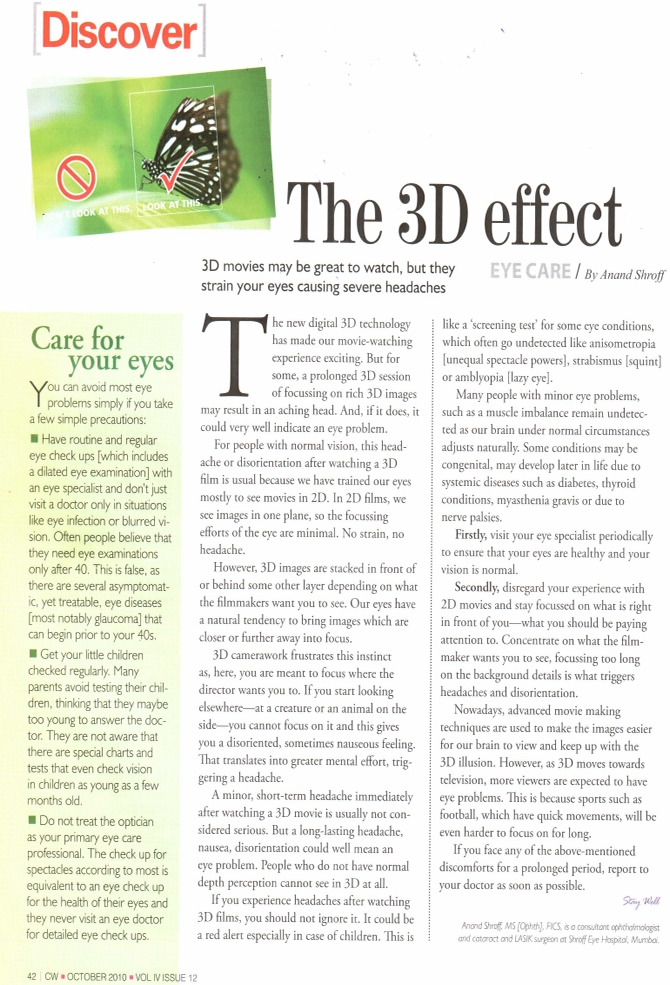
The 3D Effect

3D movies may be great to watch, but they strain your eyes causing severe headaches. The new digital technology has made our moive watching experience exciting. But for some prolonged 3D session of on focusing on rich 3D images may result in an aching head.

Contact lens

Contact lenses offer freedom from using glasses. The convenience of using them has almost made them a personal care item. Given the wide variety of contact lenses available today, choosing the right one becomes a bit confusing. Let’s understand the basics to aid you in your choice.

Soft contact lenses

Made of soft polymer-plastic, these lenses also contain some amount of water, which adds to the comfort. The more the water content, the longer they can be used.

Disposable lenses

If you suffer from an allergy, opt for daily disposable contact lenses. While some of them are for one time use, other varieties can be used frequently—for 7 days, 30 days or 90 days. Care of quarterly lenses is the same as traditional yearly soft contact lenses—these are to be removed every night, cleaned and placed in the lens case with the appropriate lens solution. They are to be thrown away after the prescribed period.

The biggest advantage of using disposable lenses is that they cut down your risk of infection, dry eye and allergies as you replace them often.

Traditional re-usable lenses

These lenses are to be changed on an annual basis. Some individuals even change them every quarter. However, the frequent replacement costs are often prohibitive. Most toric lenses [those used for blurred vision], bifocals or multi-focal lenses that help both near and far vision, fall under this category.

Extended-wear lenses

These are leave-in lenses, which can be worn continuously for up to 30 days. They are made of material that allows a higher percentage of oxygen to pass through to the cornea.

Rigid gas permeable [RGP] lenses

RGP lenses have fallen out of fashion because they take a long time to adjust. Besides, they cause a lot of discomfort as compared to soft lenses. Hence, they are prescribed only for specific corneal conditions.

Cosmetic coloured lenses

Used to alter the aesthetic appeal of your eyes, these come in a variety of shades. They often have no power and can be purchased over-the-counter without a prescription. When buying these, check their quality. These lenses are also available with special designs for fun. In case of scars or disfigurement of the eye, you can get specialised colour lenses. Most coloured lenses are soft lenses.

Can kids use contact lenses?

That depends on how responsible the child and parents are. Even a 12-year-old can become a successful contact lens wearer. However, the powers in patients younger than 18 years of age change frequently. Therefore, regular visits to the specialist are important.

Buying your first lenses?

Get a separate eye examination from an ophthalmologist or a contact lens specialist because the prescriptions for your spectacles and contact lenses may not be the same. If you buy contact lenses on the basis of your prescription for spectacles, the lenses may not be correct for you. The eye examination should include computerised mapping [topography] to check size and curvature of the cornea and microscopic corneal assessment to rule out signs of allergies, infections, dry eye, inflammation or scarring related to past contact lens wear. This checks not only vision [visual acuity] but also how well your tears work in lubricating your eyes.

Discuss in detail about your contact lens requirements with your specialist who will then recommend suitable contact lenses for you. You might be fitted with lenses for a short trial period to help you get accustomed to wearing lenses.

Don’t order the lenses till you are confident that you will be able to wear and remove them on your own. Your specialist should give you time to practise doing this. Also, learn how to clean the contact lenses, and other dos and don’ts. Only when you are comfortable with the trial lenses and the instructions, should you order them.

Dos

  • Clean contact lenses properly as per the prescribed regimen, every day as dust or debris left on them may cause temporary irritation.
  • Wash lenses thoroughly before using.
  • Clean the lenses every day even if you are not using them. Clean them and put them back in the case.
  • Replace lenses as often as prescribed.
  • Keep your nails short to avoid injuring your eyes while wearing lenses.
  • Wear your contact lens before wearing eye make-up to avoid smearing the make-up on the lenses while wearing them. Also, remove the lenses first and then the eye make-up.
  • If you are new, gradually increase the length of time you wear them every day, starting with few hours a day.

Don’ts

  • Don’t use lenses if you have dry eyes, as they further aggravate dryness.
  • Don’t use lenses if you suffer from eye allergies or repeated infections.
  • Avoid or limit the use of lenses when working for long hours on a computer as this may decrease the life span of comfortable lens wear.
  • Don’t use home-made or non-branded contact lens solutions.
  • Don’t use expired contact lenses or contact lens solutions.
  • Don’t wear your lenses while sleeping.
  • Don’t clean your lenses with water or saliva as this can cause infections.
  • Avoid using coloured contactlenses every day as it may induce contact lens intolerance faster.

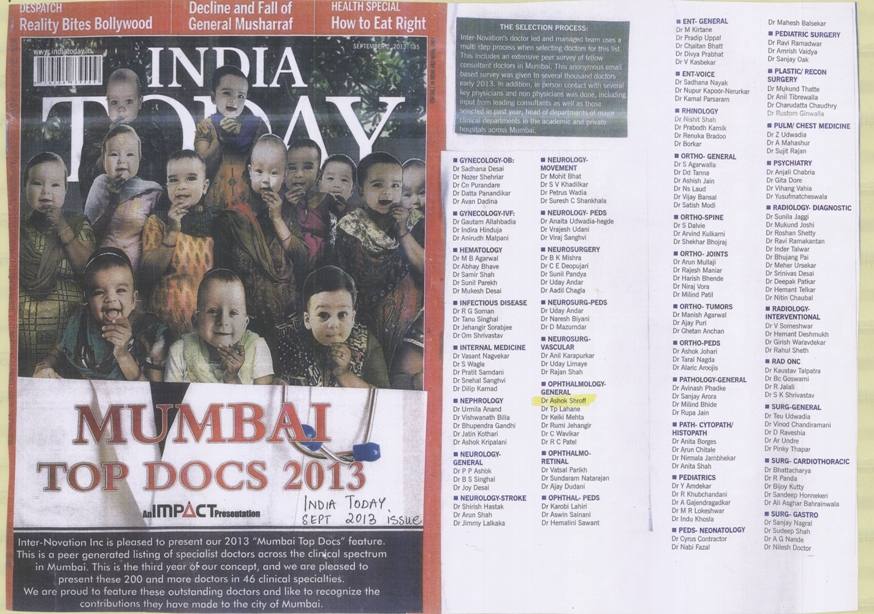
Mumbai Top Docs (India Today 2013)

Inter-Novation Inc is pleased to present our 2013 “Mumbai Top Docs” feature.

This is a peer generated listing of specialist doctors the clinical spectrum in Mumbai. This is the third year of our concept, and we are pleased to present these 200 and more doctors in 46 clinical specialties.

We are proud to feature these outstanding doctors and like to recognize the contributions they have made to the city of Mumbai.

Diabetic Retinopathy- By Dr Rahul Shroff

Diabetic Retinopathy- By Dr Rahul Shroff

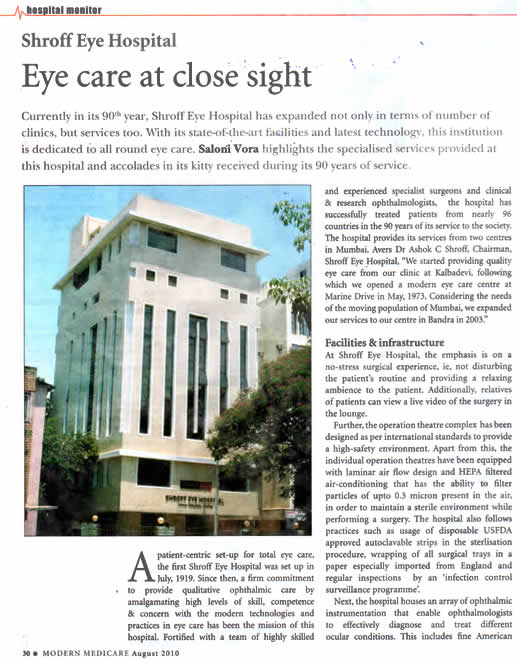
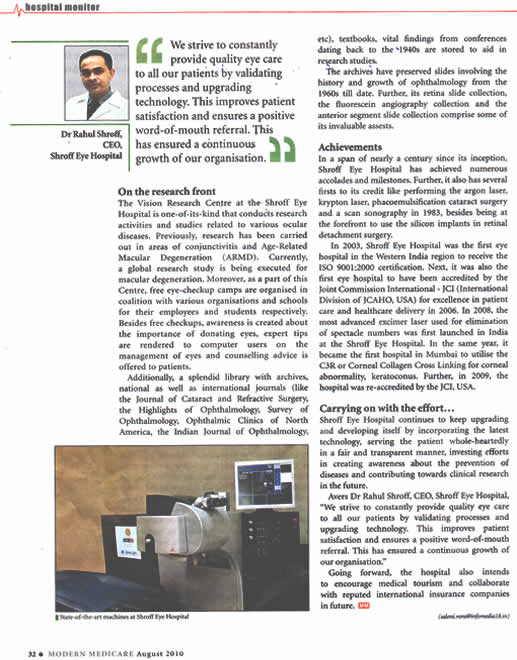
Shroff Eye provides ‘Quality Ophthalmic Care’ with the highest levels of skill, competence and concern, leading to effective care that meets patient needs and ensuring the prevention, diagnosis and treatment of various ocular conditions by adopting the latest technologies, techniques and practices in ophthalmology.

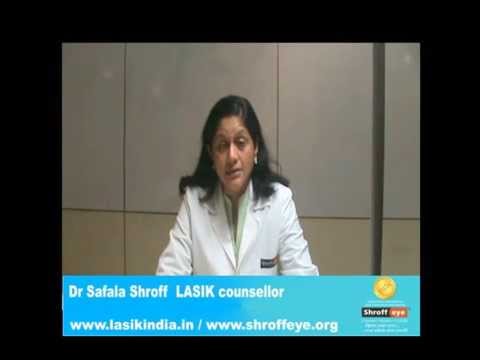
Cost of LASIK, Bladeless LASIK, Flapless LASIK

Cost of LASIK, Bladeless LASIK, Flapless LASIK

Shroff Eye provides ‘Quality Ophthalmic Care’ with the highest levels of skill, competence and concern, leading to effective care that meets patient needs and ensuring the prevention, diagnosis and treatment of various ocular conditions by adopting the latest technologies, techniques and practices in ophthalmology.

What is LASIK or Laser eye surgery?

What is LASIK or Laser eye surgery?

Shroff Eye provides ‘Quality Ophthalmic Care’ with the highest levels of skill, competence and concern, leading to effective care that meets patient needs and ensuring the prevention, diagnosis and treatment of various ocular conditions by adopting the latest technologies, techniques and practices in ophthalmology.

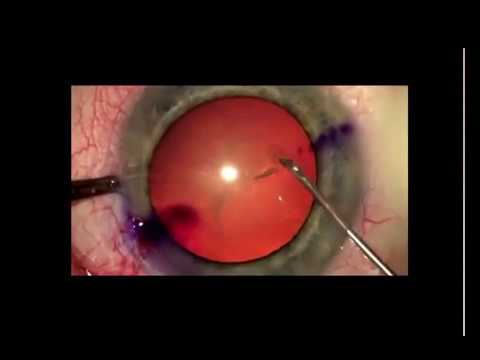
Cataract Surgery at Shroff Eye in 10 steps

Cataract Surgery at Shroff Eye in 10 steps

Shroff Eye provides ‘Quality Ophthalmic Care’ with the highest levels of skill, competence and concern, leading to effective care that meets patient needs and ensuring the prevention, diagnosis and treatment of various ocular conditions by adopting the latest technologies, techniques and practices in ophthalmology.